What is Advisory Accounting? 7 Questions Your CPA Should Be Answering.
If you own a business, you probably have an accountant. You send them documents, they file your taxes, and if you have a question, you call and hope the answer doesn’t come with a bill.
That’s compliance, and it matters. But it looks backward. By the time you’re reviewing last year’s numbers, most of the chances to change the outcome are gone.
Advisory accounting looks forward. It uses your numbers to help you make decisions before you make them: hiring, pricing, equipment, borrowing, paying yourself, and planning for taxes. The easiest way to see the difference is through the questions each approach answers.
Compliance vs. Advisory Accounting
Compliance/Traditional Accounting:
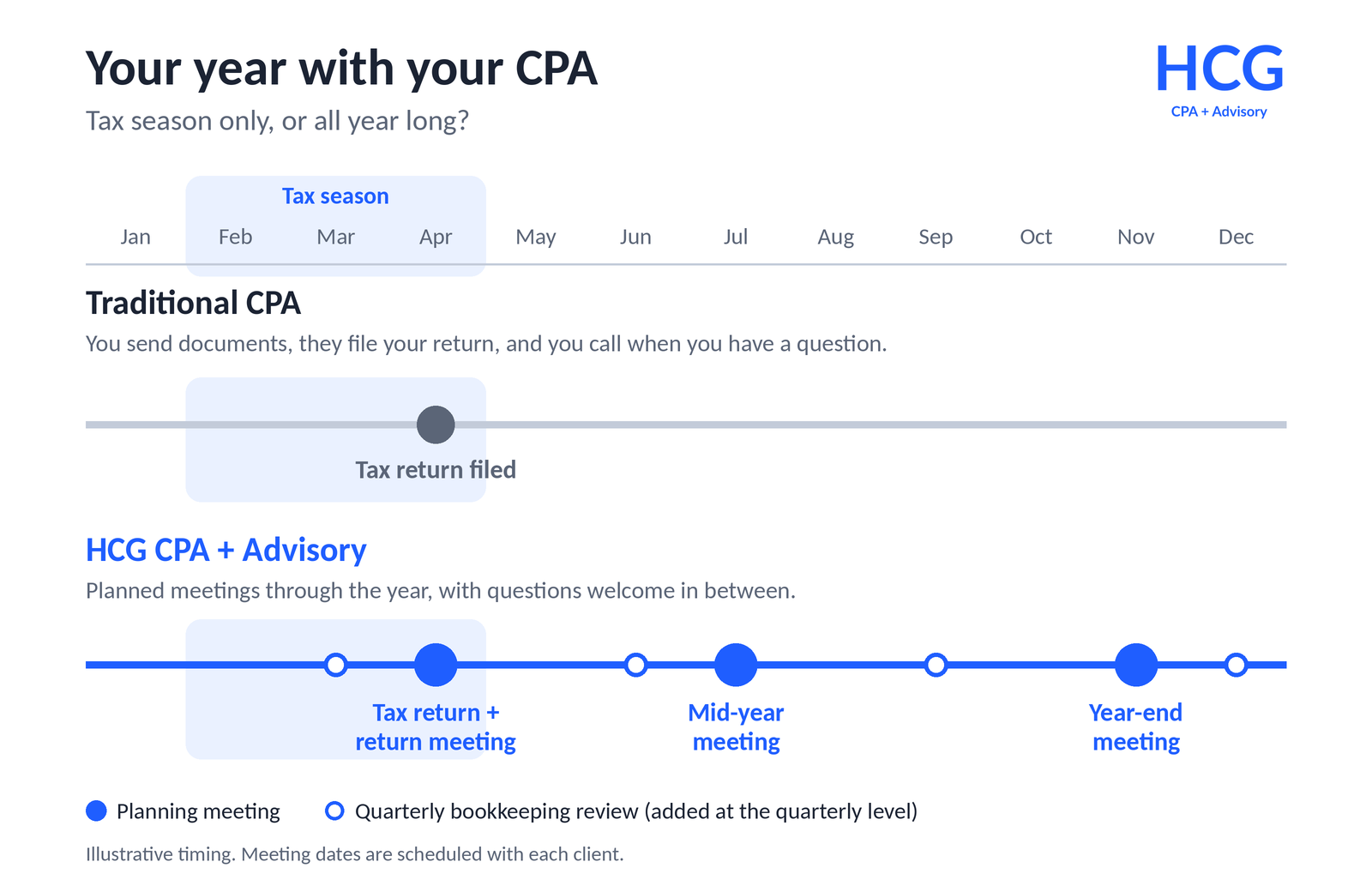
You hear from your accountant once per year, or when you call. The focus is on what happened previously and the pricing is all based on what you are asking for with a tax return or some other form as a deliverable result.
Advisory Accounting:
We sit down to establish your wants and needs and we schedule meetings regularly. We review what has happened but also discuss what your expectations are for the coming weeks, months and year. The pricing is established up front without surprises and you walk away with knowledge and a plan, as well as tax returns.
7 questions your CPA should be helping you answer
If you can’t answer these with confidence, or your CPA has never brought them up, that’s the gap advisory fills.
These are the questions we work through with our clients. How deeply we go depends on your level of service, which ranges from our base advisory relationship to full fractional CFO services.
1. How much cash will I have in 90 days?
Profit and cash are different things. A contractor waiting on retainage, a restaurant heading into a slow season, and a golf course after the season ends can all be profitable on paper and short on cash when payroll hits.
The gap: Statements show what already happened.
Advisory looks like: cash flow forecasting that shows a shortfall before it arrives.
2. Which jobs, customers, or products actually make money?
Total revenue hides a lot. Some work is far less profitable than it looked, and some of your best work may be underpriced.
The gap: Totals for the whole business.
Advisory looks like: profitability analysis broken down the way you actually run your business.
3. How should I pay myself?
Salary, distributions, and what stays in the business all affect your taxes and your cash.
The gap: An answer at filing time, when your options are limited.
Advisory looks like: a compensation plan set during the year and revisited as results come in.
4. Can I afford to hire, buy equipment, or expand?
Big decisions deserve better than a gut feeling and a glance at the bank balance.
The gap: Nothing, unless you call.
Advisory looks like: seeing what a decision does to your cash, profit, and taxes before you commit.
5. Am I paying more tax than I need to?
Most tax opportunities come from decisions made during the year, not after it closes. That’s why our clients meet with us mid-year and again at year-end, not just when a return is due. Rules change and every situation differs, so planning should always be based on current law and your details.
The gap: A return prepared after the year ends.
Advisory looks like: mid-year and year-end tax planning while there’s still time to act.
6. How do my numbers compare to what they should be?
You know your revenue. Do you know whether your labor costs, margins, and overhead are healthy for your kind of business?
The gap: Statements with no context.
Advisory looks like: tracking the key numbers for your industry over time, so problems show up early.
7. What is my business worth, and what would make it worth more?
Even if you never plan to sell, the answer shows you what lenders, partners, and buyers care about, and it shapes today’s decisions.
The gap: Rarely discussed.
Advisory looks like: understanding your value drivers and building on them.
How did you do?
If you could answer most of these, you likely already have proactive guidance. If you could answer two or three, there’s room to decide with more confidence. If you couldn’t answer most, your accountant may be doing exactly what you hired them to do. You just haven’t been offered the forward-looking part.
What advisory looks like at HCG CPA + Advisory
We built this firm because the traditional model never made sense to us: meeting with clients after the year was over, billing unpredictably, and leaving them in the dark between tax returns. You can read more in why I started the firm and why we’re evolving to HCG CPA + Advisory.
Every relationship starts the same way. We take time to understand your business, then quote a fee up front so you know what to expect. From there, the level of service depends on what you need.
Base advisory relationship: three meetings a year (in person or virtual):
• Mid-year meeting. We review how the first half went and talk tax planning and more while there’s still time to act.
• Year-end meeting. We go through your final planning options before the year closes.
• Tax return and return meeting. We prepare your return and walk through it with you, so it’s the result of the year’s conversations instead of a surprise.
Quarterly review: our most popular level
Everything in the base relationship, plus a quarterly bookkeeping review focused on keeping your books accurate and up to date, so the numbers we plan from are reliable.
Fractional CFO services
For businesses that need deeper, more hands-on financial guidance, our fractional CFO services sit at the top of the range.
At every level, questions between meetings are encouraged. We revisit the relationship annually and adjust as your business changes.
This work draws on our advisory services, tax services, bookkeeping, and fractional CFO services. If you’re in one of our core industries, see how it applies to restaurants, construction companies, or the golf industry.
Let’s talk about your situation
If a few of these questions made you uncomfortable, that’s a good sign you’re asking the right things. Schedule a conversation and we’ll walk through them together.
View More of Our Most Recent Posts