Tax Preparation vs. Tax Planning: Why March Is Too Late
Every spring, we prepare tax returns. We gather what happened last year, report it accurately, and file. That's tax preparation, and it's essential. But by the time we're preparing your return, the year it covers is already over. Almost nothing on that return can still be changed.
Tax planning happens before the year closes, while decisions can still be made. This year, that distinction isn't abstract. A real rule change took effect on January 1, 2026, and the business owners it affects need to know about it now, not next April.
What changed for 2026
The IRS raises retirement contribution limits most years for inflation. This year, one of the changes is bigger than an inflation adjustment. If you're 50 or older and earned more than $150,000 in wages in 2025, your 2026 catch-up contributions to a 401(k), 403(b), or governmental 457 plan must be made as Roth, not pre-tax. This comes from a SECURE 2.0 provision finalized by the IRS this past fall, and it's mandatory, not a choice. Under the old rule, a high earner could put that catch-up money in pre-tax and lower their current-year taxable income. Under the new rule, that catch-up amount is taxed now, in exchange for tax-free growth later.
There's a practical wrinkle too: if your retirement plan doesn't offer a Roth option, affected employees can't make catch-up contributions at all until the plan adds one. If that applies to your business, it's worth finding out before year-end, not after someone's contribution gets rejected.
The other 2026 numbers worth knowing
Account 2026 limit 2025 limit
401(k) / 403(b) / 457 employee deferral $24,500 $23,500
Catch-up (age 50+) $8,000 $7,500
Catch-up (age 60–63) $11,250 $11,250 (no change)
SIMPLE IRA / SIMPLE 401(k) deferral $17,000 $16,500
SIMPLE catch-up (age 50+) $4,000 $3,500
Traditional or Roth IRA $7,500 $7,000
IRA catch-up (age 50+) $1,100 $1,000
SEP IRA / Solo 401(k) overall limit $72,000 $70,000
HSA, self-only coverage $4,400 $4,300
HSA, family coverage $8,750 $8,550
A couple of these are worth a second look. The IRA contribution limit rose for the first time since 2023, and the IRA catch-up amount moved for the first time ever, since it had never been indexed for inflation before this year. If you've been contributing the same amount out of habit, you may be able to put in more.
Why this is a planning question, not a filing question
Here's the problem with learning about the Roth catch-up rule in April: by then, the contributions already happened, or didn't. If you're a business owner who also participates in your own company's plan, there are decisions to make before the year ends, not after:
- Does your plan allow Roth catch-up contributions? If not, this is a plan design question for your retirement plan provider, and it takes time to fix.
- Are your affected employees aware of the change? If your payroll system wasn't updated, pre-tax catch-up contributions may need to be corrected.
- Does the extra tax from a forced Roth contribution change your overall tax picture for the year? For someone in a high bracket, paying current tax on $8,000 or $11,250 that used to be pre-tax is a real number, and it's one we can plan around if we know before December, not after.
- If you're deciding between a SEP IRA and a Solo 401(k) for the business, the math has shifted now that the Solo 401(k)'s overall limit is $72,000. For many owners, the Solo 401(k) allows significantly more than a SEP at the same income, because it has an employee deferral piece a SEP doesn't.
None of this fits into a conversation that happens for the first time when we're preparing your return. It fits into a conversation that happens while the year is still open.
This is exactly what our mid-year and year-end meetings are for
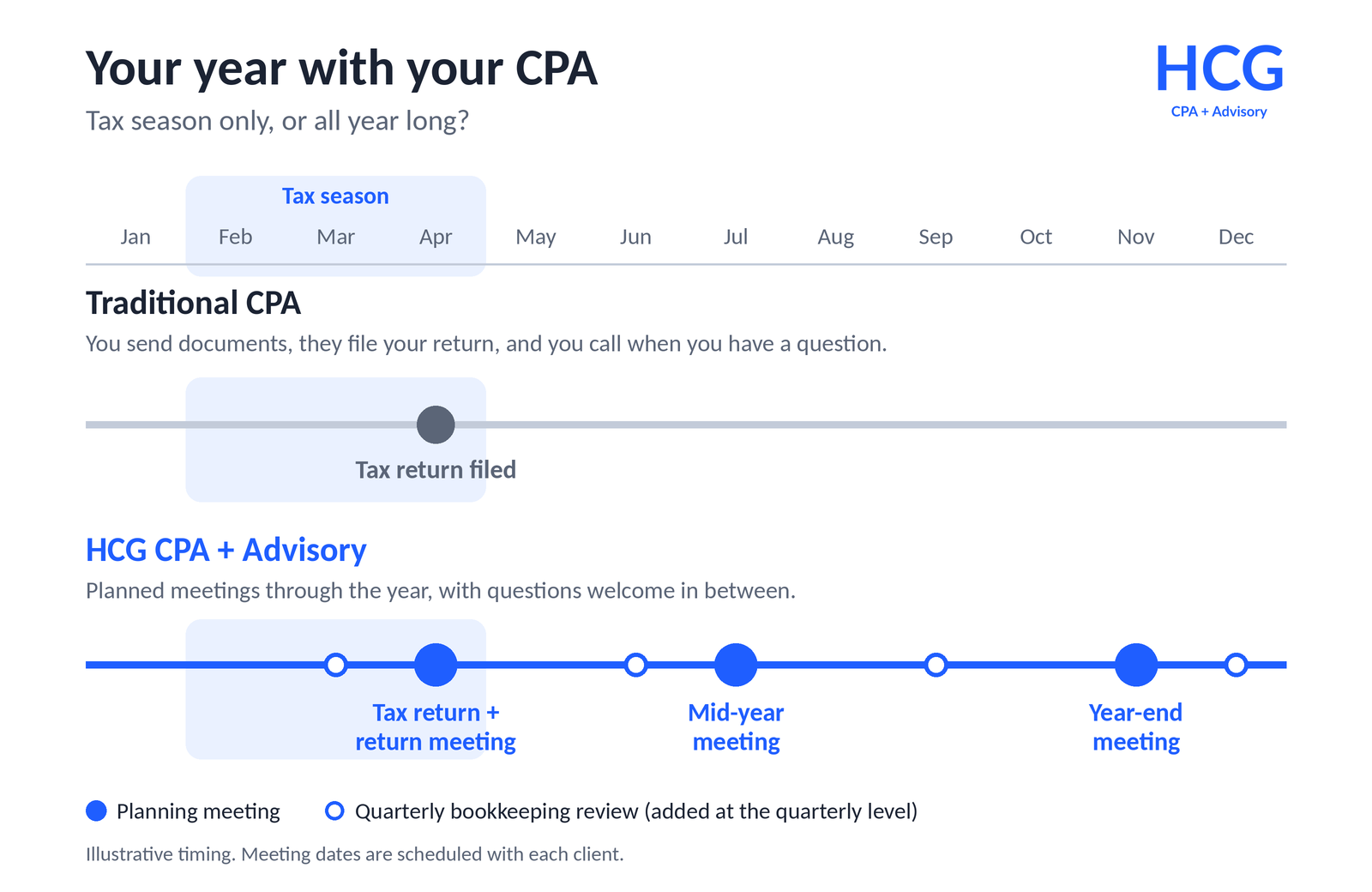
This is the kind of thing we raise with clients directly, rather than waiting for them to ask. In the base advisory relationship, your mid-year meeting is where we look at what's changed for the year, including rules like this one, while there's still time to act. Your year-end meeting is the last checkpoint before the window closes. Then your tax return and return meeting ties it together, so the return reflects decisions you made on purpose.
Clients on our quarterly review level get the same planning meetings, plus a quarterly bookkeeping review to keep the numbers we're planning from accurate and current.
If retirement plan design is part of a bigger conversation about compensation, benefits, or cash flow planning for the business, that's where our fractional CFO services come in.
Don't wait for the return to find out what you missed
If you're 50 or older, earned over $150,000 last year, and aren't sure how your plan handles catch-up contributions in 2026, that's worth a conversation now. The same goes if you haven't looked at your SEP versus Solo 401(k) decision since the limits changed.
Schedule a conversation and we'll go through what's changed and what it means for you. For a broader look at the difference between a CPA who files your return and one who plans with you throughout the year, see what advisory accounting means.
Rules like these are complex, and how they apply depends on your plan, your business structure, and your specifics. The guidance above reflects IRS Notice 2025-67 and current law as of this writing, which can change.
Michael Hunsche, CPA, founded HCG CPA + Advisory in 2017 and works with owner-managed businesses across Northeast Indiana and beyond.
View More of Our Most Recent Posts