2026 1099 Changes: What the New $2,000 Threshold Means for Your Business
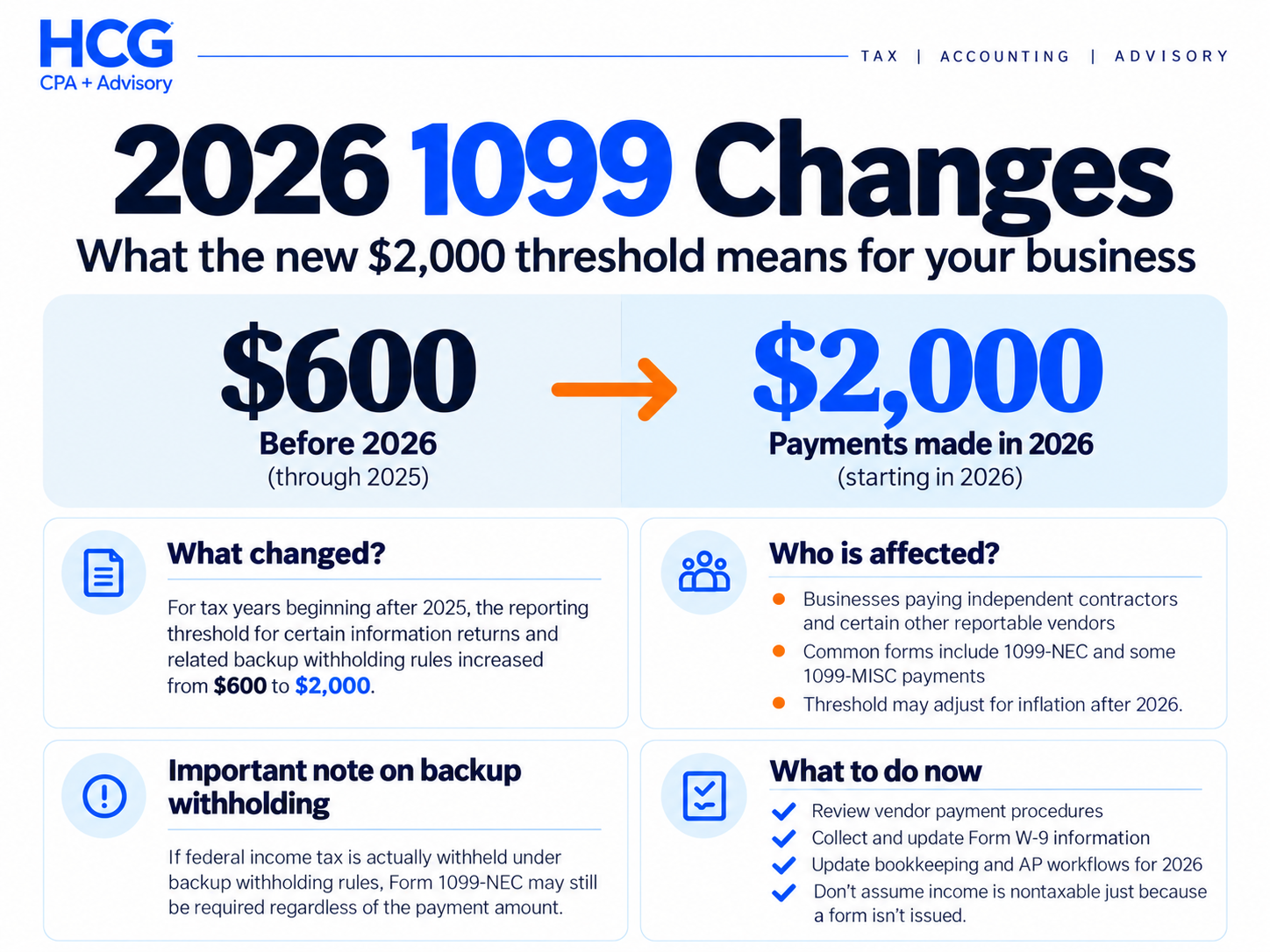
If you pay contractors, freelancers, or vendors, a real change took effect this year that affects how you track those payments. The One Big Beautiful Bill Act raised the 1099 reporting threshold from $600 to $2,000, effective for payments made after December 31, 2025. For most small businesses, this sounds like good news: less paperwork, fewer forms to issue. In practice, it also creates a new blind spot worth planning around now, not in January when 1099s are due.
What actually changed
Under the old rule, if you paid a non-employee $600 or more in a calendar year, you generally had to issue them a 1099-NEC or 1099-MISC. For 2026, that threshold is now $2,000. Starting in 2027, it will adjust annually for inflation, using 2025 as the baseline, rounded to the nearest $100. The backup withholding threshold moves with it. Backup withholding, the requirement to withhold 24% of a payment and send it to the IRS when a payee hasn't provided a valid taxpayer ID, now also kicks in at $2,000 of cumulative payments instead of $600. The withholding rate itself didn't change, only the point at which it applies.
One detail worth noting: withholding applies to the full cumulative payment once you cross $2,000, not just the amount above it. If a vendor's payments hit $2,400 for the year and you don't have a valid W-9 on file, the backup withholding exposure isn't on the $400 over the line. It's on the full $2,400.
Why the higher threshold is riskier than it sounds
Here's the part worth paying attention to. Under the old $600 threshold, most businesses got into the habit of collecting a signed W-9 from nearly every vendor early on, because almost any ongoing relationship was going to cross $600 eventually. Getting the form before the first payment was just the simplest way to not have to chase it down later.
The new $2,000 threshold removes that built-in discipline. A vendor who does a $900 job in February looks like they'll never cross the threshold, so it's tempting to skip the W-9 altogether. But that same vendor can easily pick up more work in June and October, and by December, cumulative payments have quietly crossed $2,000. If you never collected a W-9, you have no way to confirm their taxpayer ID, and you may be facing backup withholding on the full amount, after the fact, with no way to have withheld it along the way.
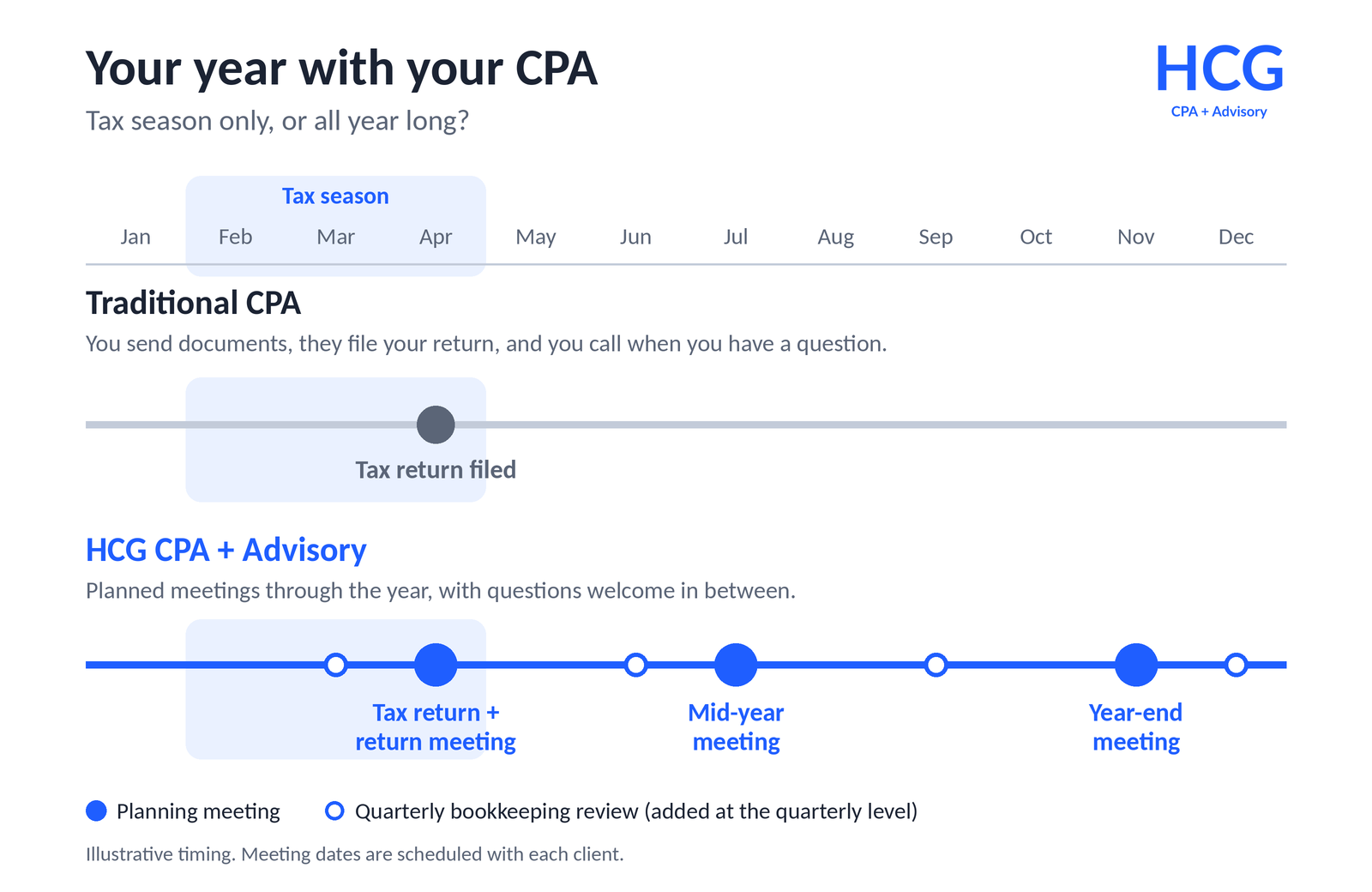
This is exactly the kind of gap that a once-a-year relationship with your CPA won't catch. By the time anyone's looking at your books to prepare 1099s in January, the payments have already gone out the door, uncollected and unwithheld, and there's no going back to fix it.
What we recommend instead
The higher threshold doesn't change the right habit, it just makes the habit easier to let slide. Our recommendation:
Collect a signed W-9 from every vendor before the first payment, regardless of how small that first job looks, unless they're clearly a corporation. This costs nothing and takes a few minutes at the start of a relationship, rather than potentially becoming a withholding problem later. If someone will not provide you with their information, withhold the 24% tax and let them know why. This ensures YOU are not on the hook for paying it on top of their full payment.
Track cumulative payments by vendor throughout the year, not just at year-end. A simple running total by vendor in your bookkeeping system flags who's approaching $2,000 before it becomes a surprise in January. Don't assume a vendor is exempt because a single payment looks small. The threshold is cumulative across the year, not per payment. If a vendor won't provide a W-9, that's when backup withholding actually matters. Withhold the 24% from that payment going forward rather than waiting to discover the problem at tax time.
This is the kind of thing we build into year-round bookkeeping and advisory work, rather than something that gets caught for the first time during 1099 season. If your books aren't being reviewed regularly enough to catch this kind of gap as it happens, that's worth a conversation. See what advisory accounting means for the broader difference between a CPA who files your forms and one who helps you stay ahead of problems like this one.
If you're not sure where you stand
If you've already made payments this year to vendors you haven't collected a W-9 from, now is the time to get that squared away, before those relationships quietly cross $2,000. Schedule a conversation and we'll help you review your vendor list and get your W-9s in order before year-end.
Rules like these can shift, and how they apply depends on your specific situation and vendor relationships. The guidance above reflects Section 70433 of the One Big Beautiful Bill Act and current IRS instructions as of this writing.
Michael Hunsche, CPA, is the founder of HCG CPA + Advisory in Fort Wayne.
View More of Our Most Recent Posts