A railway, sideways fairways, and the great homemade snacks in Scotland
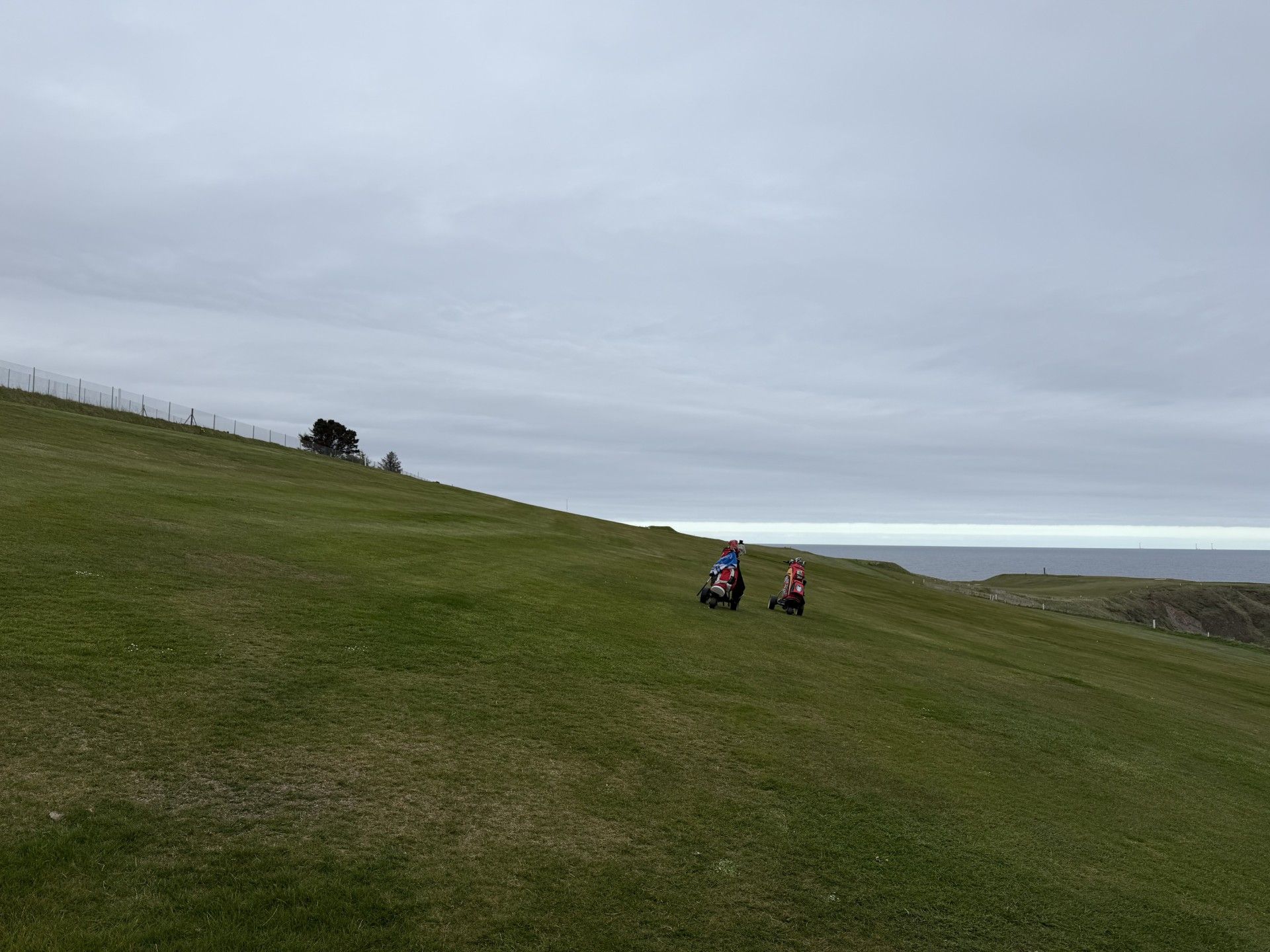
Stonehaven Golf Club sits on the cliffs of Scotland's northeast coast, between Carnoustie and Aberdeen. It isn't world famous. It's a local course, and the main rail line runs right through the middle of it. Literally. You walk under the line a few times, which is incredible on its own.
Some of the fairways slope more than 10 degrees from right to left, or left to right depending on what direction. You aim at the railline and hope gravity is on your side. It's one of the most memorable rounds I've played anywhere.
But what I remember as much as the golf was before and after the round.
The clubhouse itself was nothing special. Drop it next to any course in Indiana and you'd never notice the difference. The dining area had a few draft taps and a Guinness Microdraught system that pours a proper pint from a can (for some reason, not available in the States).
Our group was 24 Americans, all walking in at once. One server behind the bar handled every one of us. She was fast, friendly, and never missed a beat. Everyone got her charm and smile to welcome us to her club.
Then there was the food. Most small Scottish courses stick to bagged snacks, beer, and liquor. No hot dogs, no sandwiches. Just bags of “crisps” and a drink. Stonehaven had homemade cookies, fudge, and a short menu of food that was genuinely excellent but didn’t require anything more than a place to display.
Every one of us spent $10 to $20 on a bite and a drink. Nobody planned to. It was there, the service was great, and it was something we couldn't get anywhere else.
You don't need a full grill. You need something the others don't have.
Most small courses here treat the 19th hole as an afterthought. A bar, a few beers, chips, and a hot dog roller if you're lucky. It's there because golfers expect it, not because anyone runs it like a business.
Stonehaven didn't win me over with a big kitchen or a fancy building. They won with three simple things:
- Something different. Homemade cookies and fudge cost very little to make, and nobody else nearby offered them.
- A better pour. Four taps and a can-based Guinness system is a small investment that makes a drink feel like an experience.
- One great person behind the counter. Speed and friendliness turned a crowd of 24 into 24 paying customers instead of 24 people waiting.
That's the lesson for a small Indiana course. Your clubhouse doesn't have to be impressive. It has to give golfers one reason to stay ten more minutes.
What a few extra dollars per golfer adds up to
Small amounts per golfer become real money over a season. Here's an illustration using round numbers. Your own counts will differ, which is exactly why it's worth running them.
Rounds per season Extra spend per round Added revenue per season
12,000 $3 $36,000
12,000 $6 $72,000
20,000 $3 $60,000
20,000 $6 $120,000
Margin matters as much as volume. A homemade cookie that costs well under a dollar to make and sells for a few dollars carries a much better margin than a bag of chips you buy at retail. For a course that struggles to cover maintenance and payroll, that difference can decide whether the year ends in the black.
Five things a small course can try next season
- Pick one signature item. A homemade cookie, a pork tenderloin, a local baker's pie by the slice. One thing golfers talk about on the drive home.
- Go local on the taps. Partner with a nearby Indiana brewery. A local beer is a reason to order one more, and the brewery may help promote you.
- Staff for the rush, not the day. Know when the morning league and the afternoon outing come off 18. Put your best person behind the counter at those times.
- Make it easy to stay. A few good seats with a view of the 18th green does more than a remodel.
- Sell to groups up front. Offer outings and leagues a drink-and-snack add-on at booking. You lock in the revenue and plan your inventory.
The numbers worth watching
You can't improve what you don't measure. These four numbers tell you whether your 19th hole is working:
Measure How to figure it What it tells you
F&B revenue per round Food and beverage sales ÷ rounds played Whether golfers are spending at all
Capture rate Golfers who buy something ÷ total golfers Whether your offering pulls people in
Average ticket F&B sales ÷ number of transactions Whether each visit is worth more
Food and beverage cost % Cost of goods ÷ F&B sales Whether you keep enough of each sale
Most point-of-sale systems already hold this data. The work is pulling it monthly and comparing it to last year.
Your clubhouse is a hospitality business
Stonehaven reminded me that a golf course is really a hospitality business with 18 holes attached. The course gets golfers in the door. The 19th hole decides how much they leave behind.
At HCG CPA + Advisory, hospitality and restaurants are a big part of what we do. We help course owners look at the clubhouse as its own profit center, with its own P&L, its own margins, and its own goals.
In our quarterly review relationship, we track these numbers with you through the season, not just at tax time. For courses that need more, our fractional CFO service builds the budget and the plan for next year.
If you run a small course in northeast Indiana and want to know what your 19th hole is really earning, let's talk. And if you want more stories from courses around the world, follow along at Beyond the Fairway.
Michael Hunsche, CPA, is the founder of HCG CPA + Advisory in Fort Wayne.
View More of Our Most Recent Posts