“How much does a CPA cost?” is a harder question to answer than it should be, and the reason has less to do with the work itself than with how it gets billed.
Most traditional accounting relationships run on the clock. Every call, every email, every “quick question” gets tracked in six-minute increments and shows up on an invoice weeks or months later. The result is a bill that’s hard to predict and, often, a client who starts rationing questions to avoid one.
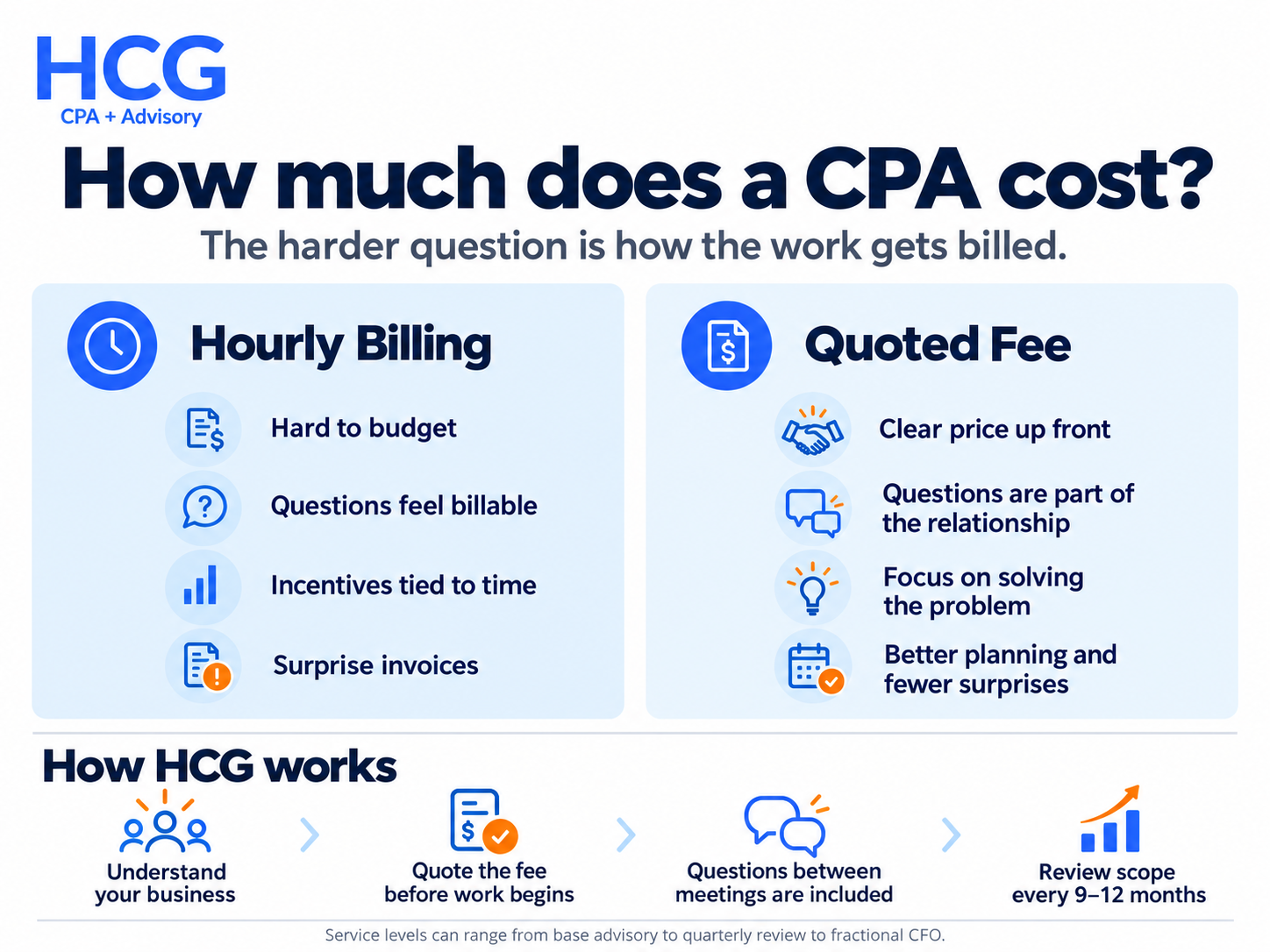
Why hourly billing works against you
Hourly billing sounds fair on the surface: you pay for the time something actually took. In practice, it creates a few problems that don’t show up until you’re living with them.
- You can’t budget for it. A fixed monthly rent payment is easy to plan around. A bill that’s $400 one month and $1,800 the next is not, especially for a business already managing tight cash flow.
- It penalizes the behavior that helps you most. The clients who call their CPA with a quick question before making a decision, rather than after, are doing exactly what we’d want every client to do. Hourly billing quietly discourages that, because every call adds to the bill.
- It rewards speed over thoroughness, for the firm. When the meter is running, there’s pressure to close out the engagement efficiently rather than ask what else the client might need to know. That’s not a knock on any individual accountant. It’s just where the incentives point.
- It creates surprises at exactly the wrong time. The businesses most likely to need extra attention, like one going through a slow season, a lawsuit, or a growth spurt, are also the ones most likely to generate a larger-than-usual bill under an hourly model, right when cash is already tight.
What a quoted fee actually changes
A flat, quoted fee flips each of those incentives.
- You know what you’re paying before the year starts. No invoice surprises, no bill that depends on how many questions you asked.
- Asking questions is free, in the sense that it doesn’t generate a separate charge. That matters more than it sounds like it should. A client who feels free to call before a decision, rather than after, is a client whose CPA can actually help prevent a problem instead of just explaining it afterward.
- The incentive shifts from billing more hours to solving the actual problem. When the fee isn’t tied to time spent, there’s no reason to stretch an engagement or rush through it. The only thing left to optimize for is whether the client’s situation improved.
- It requires the firm to actually understand your business up front, since a fee can’t be quoted responsibly without knowing what the engagement involves. That conversation, the one where we learn your business before naming a number, is itself valuable, and it’s a conversation that hourly billing skips entirely.
How this works at HCG CPA + Advisory
Every relationship starts the same way: we take the time to understand your business, then quote a fee before any work begins, so you know what to expect. From there, the level of service depends on what you need.
Our
base advisory relationship includes a mid-year meeting, a year-end meeting, and a tax return and return meeting, all built around planning ahead rather than reporting on what’s already happened. Our
quarterly review level, the one most of our clients choose, adds a quarterly bookkeeping review to keep the numbers we’re planning from accurate and current. For businesses with more complex, ongoing needs, our
fractional CFO services sit at the top of that range.
At every level, questions between meetings are part of the relationship, not a separate line item. We revisit the fee and the scope every 9 to 12 months, so it keeps matching what your business actually needs rather than what we guessed at the start.
If your current bill doesn’t make sense to you
If you’ve ever opened an invoice from your accountant and had no idea what drove the number, that’s not a sign you’re asking too many questions. It’s a sign of how the relationship is priced.
Schedule a conversation and we’ll walk through what a quoted fee would look like for your business. For the broader difference between a CPA who bills for time and one who plans with you year-round, see
what advisory accounting means.
Michael Hunsche, CPA, is the founder of HCG CPA + Advisory in Fort Wayne.